Guide
Extra mortgage payments: what $100 or $200 a month really saves
How much sooner you pay off a 30-year mortgage and how much interest you save with $100 to $1,000 extra a month or a one-off lump sum, plus prepayment penalties and recasting.
Published October 11, 2026
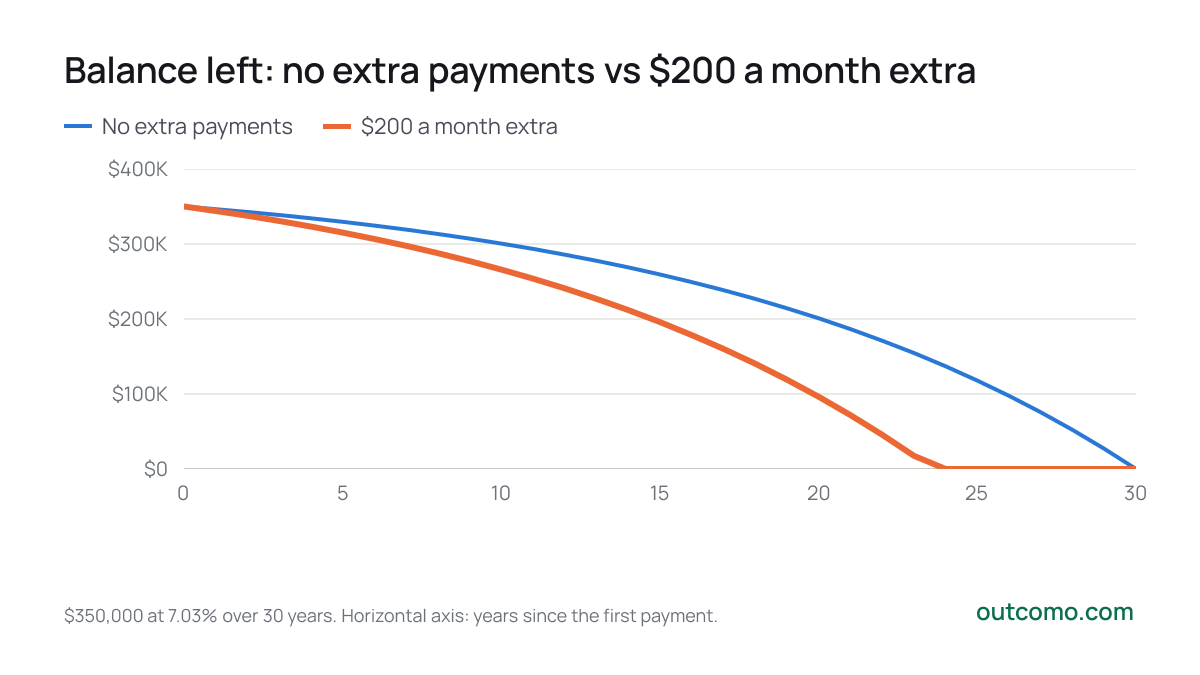
A $350,000 mortgage over 30 years at 7.03% means a payment of $2,336 a month, and over the full term you pay $490,821 in interest. Add $200 a month to every payment and you pay the loan off 6 years 4 months sooner and save $122,997 in interest.
- No extra payments
- $200 a month extra
30
- No extra payments$0
- $200 a month extra$0
$350,000 at 7.03% over 30 years. Horizontal axis: years since the first payment.
| Extra a month | Paid off in | Sooner by | Paid extra | Interest saved |
|---|---|---|---|---|
| $100 | 26 years 4 months | 3 years 8 months | $31,500 | $71,847 |
| $200 | 23 years 8 months | 6 years 4 months | $56,600 | $122,997 |
| $500 | 18 years 4 months | 11 years 8 months | $109,518 | $217,468 |
| $1,000 | 13 years 8 months | 16 years 4 months | $163,000 | $296,188 |
Why a small amount does so much
Every extra dollar goes straight to the principal. The lender no longer charges 7.03% a year on that dollar, for all the years left on the loan. An extra payment works like a deposit that earns your mortgage rate, guaranteed and without risk.
That is why the savings add up fast: $100 a month cuts 3 years 8 months and saves $71,847; $1,000 a month cuts 16 years 4 months and saves $296,188. And the money you send is not gone: you are simply paying down your own debt sooner.
A lump sum: the earlier, the better
The same goes for a one-off amount such as a bonus, a tax refund or an inheritance. A $17,500 extra payment (5% of the loan) at the end of the first year saves $98,069 and cuts 4 years 1 month off the loan. The same amount after 20 years saves only $16,397, because less debt and less interest are left by then.
| End of year | Shorter term: saved | Shorter term: sooner by | Lower payment: saved | Lower payment: new payment |
|---|---|---|---|---|
| 1 | $98,069 | 4 years 1 month | $23,554 | $2,218 |
| 10 | $48,117 | 2 years 4 months | $15,138 | $2,200 |
| 20 | $16,397 | 1 year 2 months | $6,915 | $2,132 |
Shorter loan or lower payment?
In the US an extra payment normally shortens the loan and the monthly payment stays the same. To get a lower payment instead you have to ask the lender to recast the loan, which some lenders offer for a fee. Shortening saves more: with $17,500 in the first year it is $98,069. A recast saves $23,554 and lowers the payment by $118 to $2,218. A lower payment helps when your budget is tight; if it is not, keep the payment and shorten the loan.
What to check first
- Prepayment penalty. Most mortgages let you pay extra at any time, but some charge a fee if you pay off all or a large part early, usually in the first few years. Your loan documents say whether yours has one; ask your servicer if in doubt.
- Tell the servicer where the money goes. Mark the extra as a payment toward principal, otherwise it may be held or applied to the next payment.
- Emergency fund first. Money paid into the house is hard to get back out. Keep a few months of expenses in cash.
- Costlier debt first. Credit cards and personal loans usually charge more than a mortgage, so paying them off saves more.
- Pay down or invest? An extra payment earns exactly your mortgage rate, for sure. Investing may earn more over the long run, without a guarantee. The higher your rate, the stronger the case for paying down.
Try your own loan, rate and extra payments in the mortgage calculator (Advanced mode).
Work it out for yourself
Mortgage Calculator
Related articles
- Guide
When an adjustable-rate mortgage resets: your new payment
How much an ARM payment rises or falls when the fixed period ends, why the new rate applies to almost the whole loan, and what you can do before the reset.
- Data
US home prices by state: how much they have risen since 2015
How home prices have changed in the US and in every state according to the FHFA index, how much of the rise inflation took and where prices rose the most.
- Data
Stocks, bonds and cash since 1928: what earned the most
What $100 in stocks, bonds and cash since 1928 would be today, what was left after inflation, how long losses lasted and what it means for investors.
Data sources
- Freddie Mac, Primary Mortgage Market Survey (30-year fixed)
- Consumer Financial Protection Bureau, What is a prepayment penalty?
The article is for information only and is not financial, tax or legal advice. The numbers come straight from the sources above and change when they are updated.