Comparison
Lump sum or dollar-cost averaging? What S&P 500 history says
Should you invest a windfall at once or spread it over a few months? Every start since 1993 compared: how often the lump sum came out ahead, by how much, and when spreading it out helped.
Published October 11, 2026
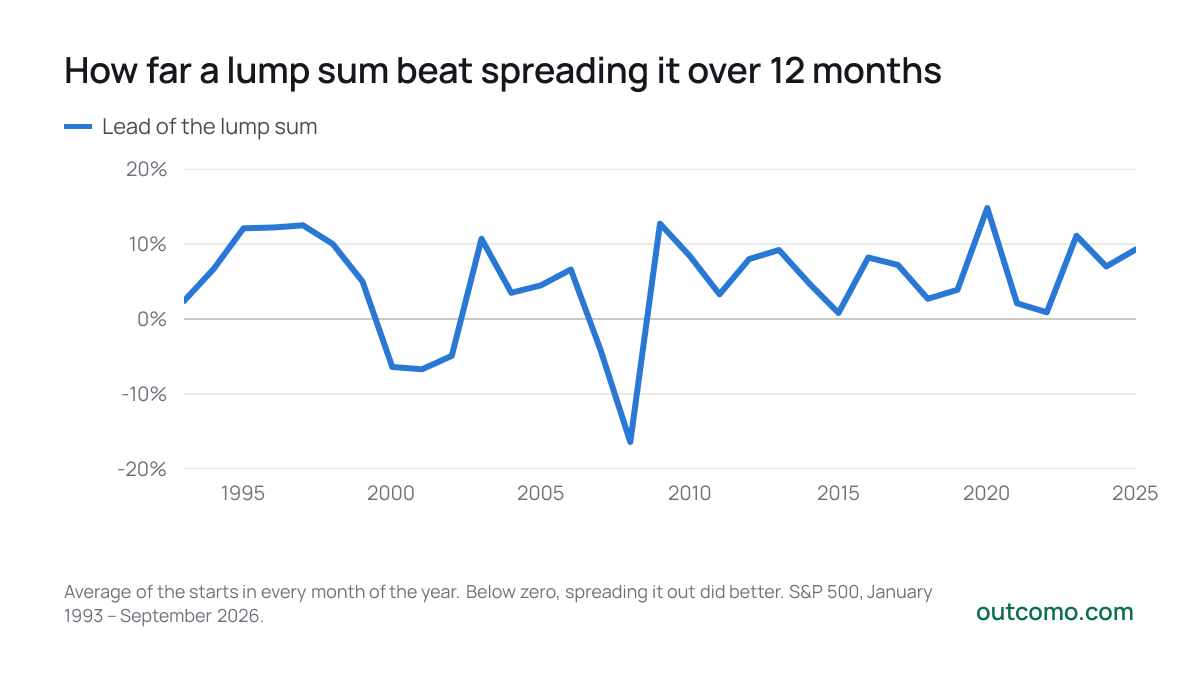
You have $100,000 to invest. Put it all in now, or spread it over 12 months at $8,333 a month? The history of US stocks gives a clear answer: out of 394 possible starts since 1993, investing it all at once came out ahead 80% of the time, typically by 5.9% (about $5,910). Spreading it out does protect against the worst case, though: anyone who invested everything in May 2008 had 29% less a year later.
- Lead of the lump sum
2025
- Lead of the lump sum9.3%
Average of the starts in every month of the year. Below zero, spreading it out did better. S&P 500, January 1993 – September 2026.
Why the lump sum usually wins
Stocks rise more often than they fall. Money still waiting for its turn misses that growth, and the longer it waits, the more it misses. So the longer the spread, the more often the lump sum wins: 67% of the time over three months, 83% over two years, typically by 12%.
| Spread over (months) | Starts | Lump sum ahead | Typical difference | Best | Worst |
|---|---|---|---|---|---|
| 3 | 403 | 67% | +1.2% | +10% | -14% |
| 6 | 400 | 72% | +2.8% | +18% | -23% |
| 12 | 394 | 80% | +5.9% | +31% | -29% |
| 24 | 382 | 83% | +12.3% | +47% | -28% |
When spreading it out did better
Spreading helped mostly for starts in 2000, 2001, 2002, 2007, 2008, when a fall in stocks followed soon after. The worst start was May 2008: $100,000 invested at once was worth $63,930 a year later, the same amount spread over 12 months $89,425. The lump sum ended more than 10% behind in 25 of 394 starts (6%). Its biggest win came from a start in February 2009, by 31%.
Nobody can spot those moments in advance. But if a drop right after investing would make you sell, spreading it out is reasonable insurance: you typically give up 5.9% and in return avoid the worst starts.
Investing from every paycheck is a different situation
When you invest part of every paycheck, there is no choice to make: you do not have the money up front. Regular investing is then the best you can do, and its ups and downs even out over time. This article is only about the case where you already have the whole sum, from a home sale, an inheritance or a bonus.
What it means for you
- With the money in hand and a long horizon, history favors investing at once. Depending on the length of the spread it came out ahead 67% to 83% of the time.
- Spreading is insurance, not a way to earn more. It makes sense if a drop right after investing would shake you.
- If you spread, keep it short. The longer the money waits, the more it costs on average.
- The past is no guarantee. This is one market in one period; money you will need soon does not belong in stocks at all.
See also: Buying bitcoin every month since 2014
See how your own amount and period would have done in the DCA calculator (History mode): it compares regular investing with putting the whole amount in at once.
Work it out for yourself
DCA Calculator
Related articles
- Data
Buying bitcoin every month since 2014: what it would be worth today
What a fixed monthly purchase of bitcoin since 2014 would be worth today, how deep it fell along the way, how much the start year matters and how it did against the S&P 500.
- Data
Stocks, bonds and cash since 1928: what earned the most
What $100 in stocks, bonds and cash since 1928 would be today, what was left after inflation, how long losses lasted and what it means for investors.
- Comparison
A 0.2% or a 1.5% fund fee: what the difference costs over 30 years
How much a yearly fund fee takes from regular investing: the numbers for fees from 0 to 2%, a front-end load, a lump sum and where to find what a fund costs.
Data sources
The article is for information only and is not financial, tax or legal advice. The numbers come straight from the sources above and change when they are updated.